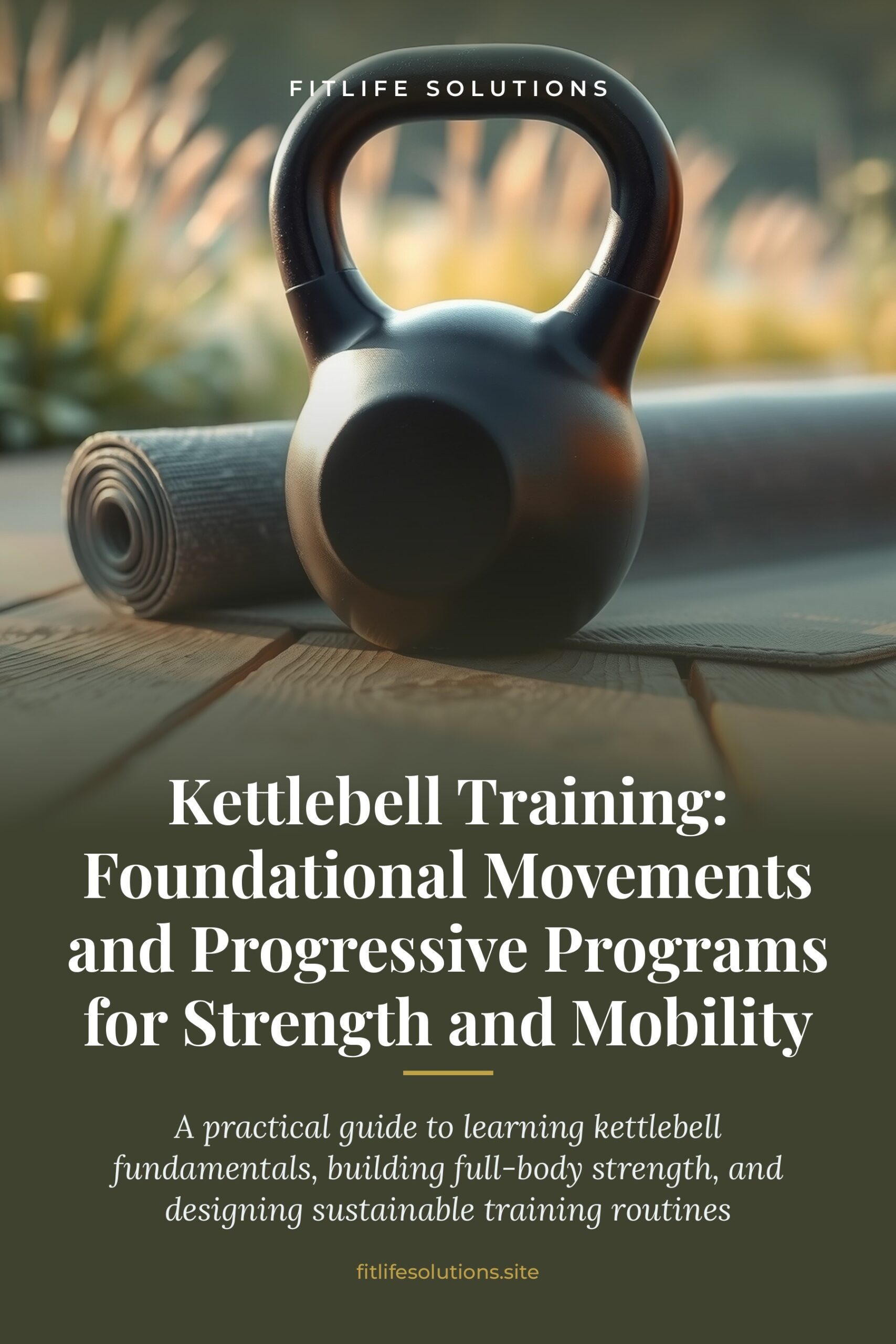
Kettlebell Training: Foundational Movements and Progressive Programs for Strength and Mobility
A practical guide to learning kettlebell fundamentals, building full-body strength, and designing sustainable training routines.
From the introduction
This book is written for adults who want a practical, space-efficient way to build strength and mobility using kettlebells. It serves beginners learning proper form from the ground up, as well as intermediate trainees refining technique and programming their own progress. If you have limited equipment, limited space, or limited time but still want systematic strength development, kettlebell training fits those constraints.
What’s inside, chapter by chapter
Chapter 1: Understanding Kettlebell Design, Weight Selection, and Safety Fundamentals
A kettlebell differs from a dumbbell in one critical way: its center of mass sits below and in front of the handle rather than in line with your grip. This offset design creates a longer lever arm, which challenges grip, forearm stability, and core engagement throughout every movement.
Chapter 2: Mastering the Deadlift, Swing, and Clean: Core Hip-Hinge Patterns
The hip hinge is the engine behind every powerful kettlebell movement. Unlike a squat, where the knees bend deeply and the torso stays relatively upright, the hinge pushes the hips back while the knees bend only slightly.
Chapter 3: Developing Overhead Stability with the Press, Push Press, and Snatch
Overhead pressing with a kettlebell demands more than shoulder strength. The offset center of mass pulls the wrist into extension and the elbow away from the midline, forcing the rotator cuff, scapular stabilizers, and core to work together.
Chapter 4: Building Lower-Body Strength Through Goblet Squats, Lunges, and Single-Leg Work
The goblet squat teaches the squat pattern while the kettlebell acts as a counterbalance. Holding the bell by the horns at chest height pulls the center of mass forward, which encourages an upright torso and helps beginners find depth without collapsing forward.
Chapter 5: Integrating Core Engagement with Turkish Get-Ups, Windmills, and Loaded Carries
The Turkish get-up teaches the body to move as a coordinated unit while maintaining a stable overhead position. Unlike isolated core exercises, it demands shoulder stability, hip mobility, thoracic rotation, and anti-rotational strength simultaneously.
Chapter 6: Designing Balanced Weekly Programs: Volume, Frequency, and Progression Strategies
A balanced kettlebell program distributes movement patterns across the week so that no single joint or muscle group bears excessive load on consecutive days. The hip hinge, squat, press, and core integration patterns each need recovery time.
What you receive
- A digital eBook – PDF and EPUB. Nothing physical is shipped.
- One-time payment of $37. No subscription.
- Payment and refunds are handled by Digistore24 (60-day refund policy).
This book is for general information and education only. It is not a substitute for medical advice, diagnosis or treatment. Always consult your doctor before changing your diet, exercise or medication.