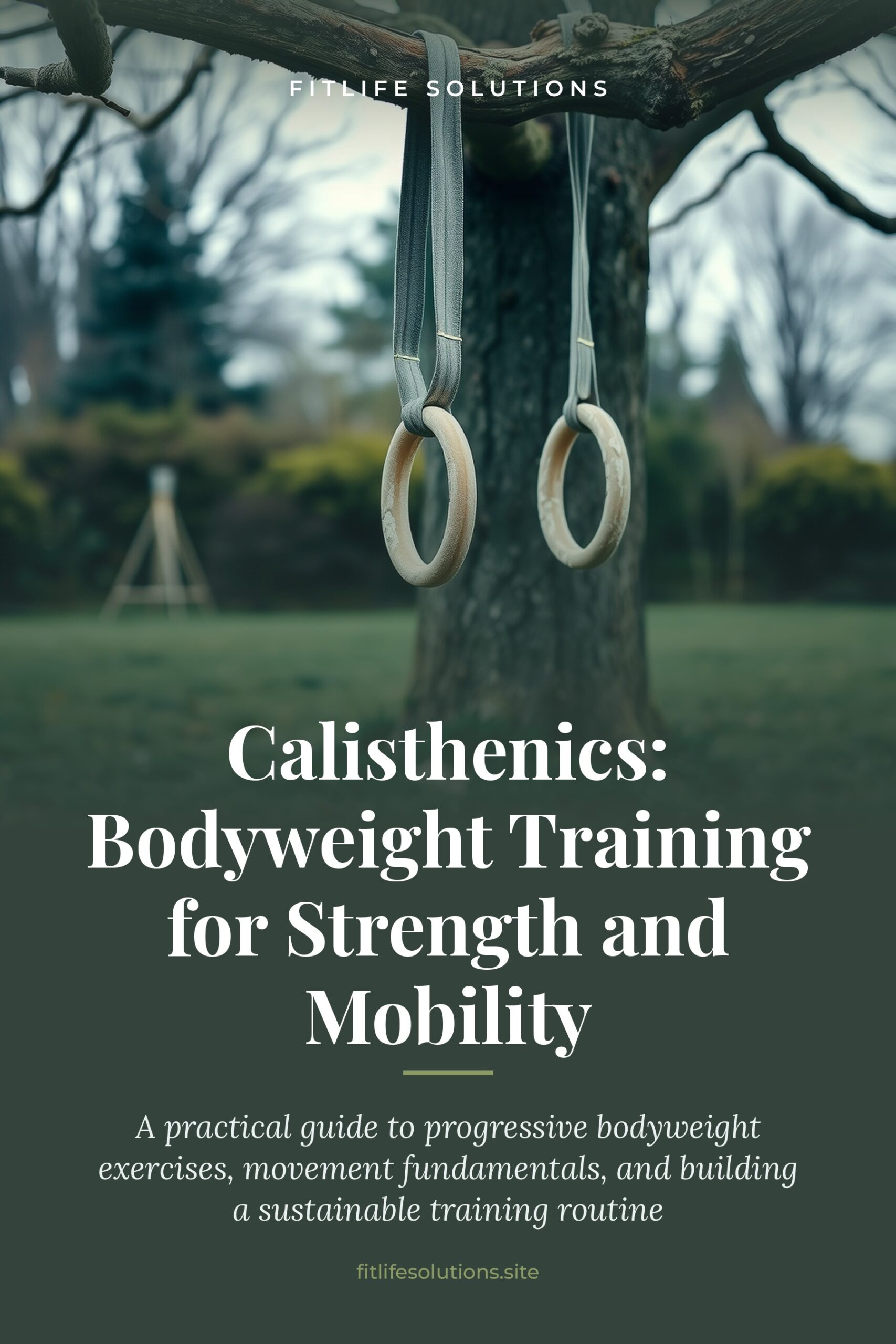
Calisthenics: Bodyweight Training for Strength and Mobility
A practical guide to progressive bodyweight exercises, movement fundamentals, and building a sustainable training routine.
From the introduction
This book is for adults who want to build strength and improve mobility without a gym membership or equipment. Whether you are starting from zero, returning after a break, or looking to deepen an existing calisthenics practice, the progressions here meet you at your current level. The requirements are a floor, a wall, a solid doorframe, a heavy table or low bar that cannot tip, and, for vertical pulling, a securely fixed overhead bar or beam built to hold your body weight.
What’s inside, chapter by chapter
Chapter 1: Foundations: Movement Patterns, Joint Preparation, and Assessment
Calisthenics builds on a small set of movement patterns that appear in every exercise you will learn. These patterns are the push, the pull, the squat, the hinge, the lunge, and the carry or hold.
Chapter 2: Push Progressions: From Wall Push-Ups to One-Arm Variations
The push pattern in calisthenics trains the chest, shoulders, and triceps through horizontal and vertical pressing. Before adding difficulty, understand what the scapulae should do.
Chapter 3: Pull Progressions: Doorframe Rows to Towel Pull-Ups and Beyond
A doorframe row is the most accessible horizontal pull for beginners. Stand facing an open door, feet hip-width apart, and grip the doorframe at shoulder height with both hands.
Chapter 4: Lower Body Series: Squats, Lunges, Single-Leg Work, and Plyometric Basics
The squat is the foundational lower body movement pattern. It trains the quadriceps, glutes, hamstrings, and calves while demanding core stability and hip mobility.
Chapter 5: Core and Mobility Integration: Hanging, Planking, and Dynamic Flexibility
Hanging from a bar or sturdy overhead structure builds grip strength, lets the spine lengthen gently, and teaches the shoulders to stabilize under load. Start with a dead hang: grasp the bar with hands slightly wider than shoulders, palms facing away, and let your body hang completely relaxed.
Chapter 6: Programming: Weekly Structure, Deloads, and Long-Term Progression
A sustainable calisthenics program balances frequency, intensity, and recovery. Most adults training without equipment do well with three to four dedicated sessions per week, each lasting 45 to 60 minutes including warm-up and mobility work.
What you receive
- A digital eBook – PDF and EPUB. Nothing physical is shipped.
- One-time payment of $37. No subscription.
- Payment and refunds are handled by Digistore24 (60-day refund policy).
This book is for general information and education only. It is not a substitute for medical advice, diagnosis or treatment. Always consult your doctor before changing your diet, exercise or medication.